


 Log In
Wounded Warriers Canada, Parkinson’s Canada: Cycling fundraisers cross paths
Posted on August 27, 2026 by Ryan Dahlman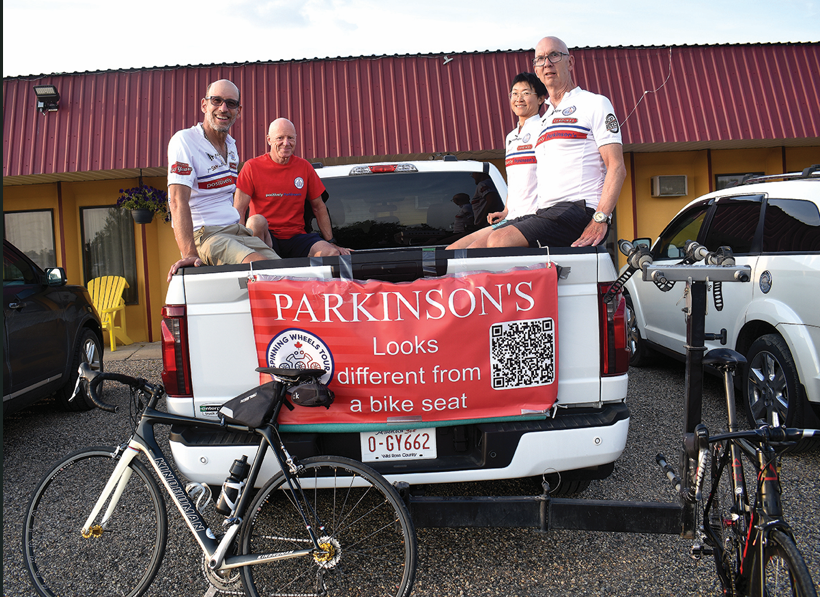 Parkinson’s research advocates: Cycling group at Maple Creek Motor Inn.
 By Marcus Day
Maple Creek News
Two cycling journeys, two causes, two goals – to raise funds and awareness. It is hoped that greater awareness will help bring down the walls of stigma-induced silence around PTSD and Parkinson.
For nine days in August, Rob Nederlof, a retired Canadian Armed Forces sergeant, cycled through parts of Alberta and Saskatchewan for Wounded Warriors Canada’s Operational Stress Intervention Dogs program.
It was his fifth annual Prairie Thousand fundraiser, helping veterans and first responders living with trauma. Meanwhile, Phil Rayner, Li Jiang, Steve Iseman, and Brett Bowe are part of the Spinning Wheels Tour, riding from Western Canada, through Saskatchewan, and on to Winnipeg, in support of those with Parkinson’s. Three of them live with the disease – Rayner, Jiang and Iseman – and know how important it is to bond, drawing strength from each other.
By chance, Nederlof and the Spinning Wheels Tour cyclists met at the Alberta-Saskatchewan border.
Their destination that day? Maple Creek.
As they rode the final 60 kilometres together, sharing stories, one thing became clear quickly. Their causes may be very different, but there was a common denominator – the stigma and silence surrounding operational trauma, or Post-Traumatic Stress Disorder (PTSD), and Parkinson’s.
Another commonality was the therapeutic benefits of cycling, which stops the mind from travelling to dark places, and gives a sense of physical wellbeing.
These connections between the two fundraising efforts were highlighted later during separate interviews with the News-Times on Sunday, August 16.
After settling in at Willowbend campground, Nederlof spoke about the rationale behind the Prairie Thousand.
The retired mechanic has first-hand experience of stress injury after serving in the Canadian Armed Forces for 26 years, including postings in Edmonton and at Canadian Forces Base Shilo in Manitoba, and completed three overseas tours, one in Bosnia and two in Afghanistan.
He has encountered many people living with PTSD and other mental challenges.
His efforts support service dogs trained to recognize signs of distress, intervene during episodes and help their handlers regain independence.
“I have seen the benefits,” he said.
Nederlof said there was still a stigma attached to mental trauma, and many of those affected continue to suffer in silence.
“We need to break that silence.”
Iseman said the same applied to Parkinson’s.
He, Jiang and Rayner faced many years of trying to suppress their symptoms and living in denial.
Why is there a stigma?
According to studies and research, some signs of Parkinson’s are obvious to the outside observer, such as tremor, stiffness, slowness and or walking problems. Other non-motor symptoms, however, including depression, anxiety, and apathy are less visible.
Both aspects can be misinterpreted. Slowness of movement or speech may be seen as intellectual disability, imbalance as drunkenness, masked facial expression – something that Rayner has – as unfriendliness, and tremor as nervousness.
Presently, more than 120,000 Canadians are living with Parkinson’s, and that number continues to grow.
Research shows men are 1.5 times more likely to develop Parkinson’s than women.
About 14,800 people were diagnosed with Parkinson’s in 2023 to 2024, 60 per cent of which were male and 40 per cent female, according to Parkinson Canada.
Health organizations estimate that roughly 25 to 30 Canadians are diagnosed every single day, which equates to 9,000 to 11,000 new diagnoses each year.
By 2034, the number of Canadians living with Parkinson’s is expected to climb to more than 150,000.
It is a reality that everyone has to confront, says Iseman, including Maple Creek residents. Ignoring Parkinson’s, or denying its existence, won’t stop its increasing prevalence.
“We are here to raise awareness about it,” he said.
Leave a Reply
You must be logged in to post a comment.