


Rural ranching women celebrated; educated at workshop in Maple Creek
Posted on February 11, 2026 by Ryan Dahlman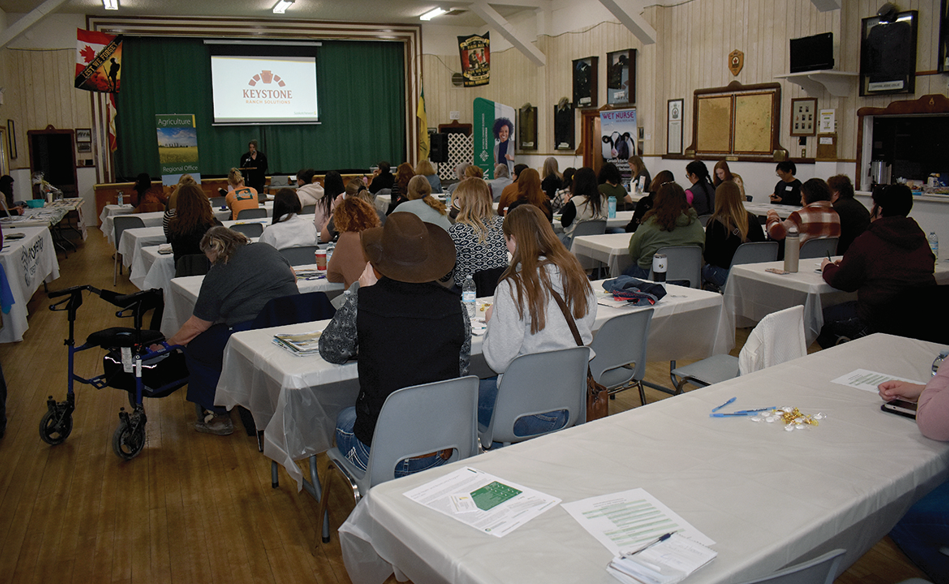
By Marcus Day
Maple Creek News
Last week, Dr. Klea-Ann Wasilow, a practising partner in Maple Creek Veterinary Services, delivered tips on calving season during a two-day Ministry of Agriculture workshop titled “Celebrating Rural Ranching Women”.
The workshop, designed to build skills related to livestock management and ranch management, ran from Feb. 4-6 at Maple Creek Legion Hall and featured a full program of activities and presentations. Topics included range management, genetics and nutrition.
It is the most exciting of times, it is the most stressful of times.
For ranchers and farmers, calving season means witnessing new life appear, but it can also mean less sleep and facing multiple challenges from Mother Nature.
It carries risks too. Such as Q fever, a disease caused by bacteria transmitted to humans from infected livestock.
Dr. Klea-Ann Wasilow, a practising partner in Maple Creek Veterinary Services, can testify to the misery wrought by an infection whose symptoms often mimic severe flu.
For those with pre-existing heart issues, the impact can be severe.
“Been there, done that – I don’t want to repeat that,” she said.
Her experience underlines the importance of taking safeguards, such as gloves, during the calving process.
Dr. Wasilow’s comments came as she delivered a slideshow presentation, “Calving Season Tips: Preparation, Intervention, and Cow/Calf Care”, at a two-day Saskatchewan Government workshop at Maple Creek Legion Hall.
Another speaker was Dr. Gary Hoium, a veterinarian-turned author, who has released two volumes of vet stories, each one titled “Don’t They KICK When You Do That?”.
Dr. Hoium, who tended to large and small animals of Weyburn area residents for more than 40 years, building a huge catalogue of stories, took full retirement from being a veterinarian in November of 2021, which allowed him more time to spend on writing.
Also well-received was a “Peaks and Pits” session, intended to drive discussion through a show-and-tell style presentation by a panel made up of ranch women from the region.
The workshop – which last week featured such wide-ranging topics as targeted grazing, genetic testing, bottle feeding livestock, cost of production, and the Sustainable Canadian Agricultural Partnership programming – rotates throughout the province each year and is open to women from anywhere in the province.
The cost to attend last week was $75 for both days or $105, which included an evening activity in which Crafty Creations by Tara led a decorated doormat activity.
From Thursday to Friday, the hall was filled with women ranchers, and agriculture specialists who had set up work stations near the walls.
Corissa Wilcox, a livestock and feed extension specialist from the Ministry of Agriculture’s Regional Services Branch, opened the event, with an official welcome and land acknowledgment.
“Speed Dating with the Specialists” followed in which attendees split into groups to listen to personnel from the Ministry and partnering organizations speak about their programs, funding and activities. Afterwards, there was a chance for questions.
The six sessions were: Saskatchewan Association of Watersheds (SAW) – agricultural programming for your operation and aquatic species at risk project; AES – international year of rangelands and pastoralists & tame forage species selection; Saskatchewan Stock Growers Foundation (SSGF) – Plant ID basics; Canadian Forage and Grassland Association (CFGA) – Beyond bared wire: virtual fencing in Saskatchewan; Range Management Extension Specialist (RMES) – Rejuvenation: establishing alfalfa into an existing grass stand; and Saskatchewan Crop Insurance Corporation (SCIC) – Soil moisture content pilot project.
Wilcox then introduced Dr. Wasilow, whose talk was divided into four sections: calving season preparation; calving/dystocia intervention; cow care; and neonatal care.
The slides showed five key aspects of preparation:
The calving area should be well-bedded, protected from the wind. The feed area should have minimal mud/manure.
Calving equipment: tail ties, disinfectant soap, disinfectant solution, lubricant (premixed or powder J-Lube), exam gloves, OB sleeves, syringes/needles, Sharps container, weight scale or weight tape, nursing bottles or tube feeding bags. Kit – tote, tool kit, grooming kit.
Products: Colostrum; antimicrobials (for the cow, focus on reproductive tract infections, mastitis for the calf, focus on Bovine Respiratory Disease (BRD), navel health); anti-inflammatory (pain control) – cow and calf; calming pheromone products; antibody pastes; electrolytes; vaccines (BRD.Scours).
Cattle Records: Use paper, electronic, or online, and update before the season starts. Enter as often possible through the season to avoid getting behind.
The People: Ranchers should ensure they have nutritious meals, and prioritize rest and sleep, taking shifts at night, and naps during the day. Fitness and exercise are also important. Safety is another key factor, especially when working alone or fatigue creeps in. Make sure there is adequate lighting (high lumen rechargeable lights are a game changer).
Addressing calving/dystocia intervention, Dr. Wasilow spoke about calving chains or straps for assisting with difficult deliveries. Using stuffies for a demonstration, her tips were: Always double loop; always have the tension pulling so the joint can flex or bend; eyes or loops will be on the top of the joint or front of foot.
After an intervention, said, Dr. Wasilow, the cow should be assessed for further support. Her advice was: be clean, wear gloves/sleeve.
Post-delivery re-assessment should focus on checking the vaginal vault and uterus, checking for injuries (tear or bleeding) and another calf.
“If there is a twin, check for a triplet too,” said Dr. Wasilow.
Cow care postpartum is another key part of calving season.
“Think about developing a healthy cow-calf bond and setting her up for a strong lactation.”
Dr. Wasilow listed contributory factors to a failure of bonding: stress, isolation, infection and pain. Some cows, she added, are just not meant to be mothers.
A cow’s lactation could be affected by reduced access to water and high qualify feed, grain overload, illness, stress or steroid administration.
Dr. Wasilow asked: What can you do if a calf won’t breathe after delivery?
Her suggestions were: poke straw up the nose or shake by the nose; careful ear stimulation; rub vigorously; put the calf in the recovery position; and GV 26 Acupuncture point (middle of the nose, tiny needle).
The possibility of respiratory acidosis, caused by a delay in stage two of the birthing process, in which the calf does not inhale or exhale while stuck in the birth canal, is another concern.
Symptoms include staggering, weakness and a coma. Treatment options are: place in recovery position for quicker return to normal respiration; resuscitate with a CPR mask and bag; and consult with a CPR mask and bag.
Dr, Wasilow went on to talk about colostrum – the thick, yellowish nutrient-dense first milk produced by mammals, including humans and cows, during late pregnancy and for the first 2-4 days after delivery. When the cow doesn’t naturally produce it, or enough of it, colostrum products are available.
Colostrum, she said was critical for every calf within the first six hours of life.
“Obsessing about colostrum consumption is the single most valuable thing you can do for each calf and your entire herd. If in doubt, get the colostrum out.”
- Information in Dr. Wasilow’s presentation can be obtained from the Beef Cattle Research Council (beefresearch.ca)
Leave a Reply
You must be logged in to post a comment.