


Deep dive into trauma: Maple Creek Composite School brings 3D Virtual Reality Series on Residential School system
Posted on March 25, 2026 by Ryan Dahlman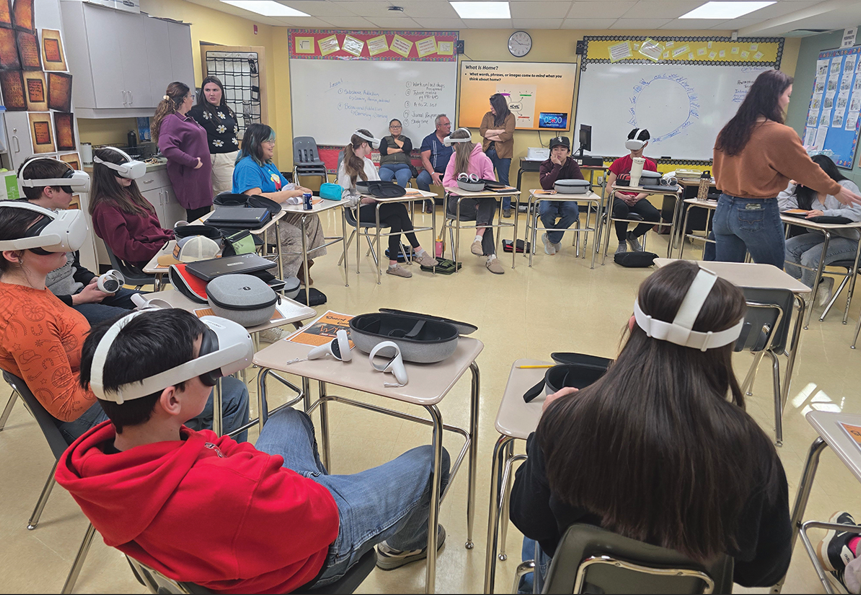 Entering a virtual world: Grade 9 MCCS students engage in the first episode of the William 360 Experience. Photo submitted by Rob Stewart
By Marcus Day
Maple Creek News
When Kennedy Glascock and Lina Berndtsson went to a national indigenous education symposium in the fall, they heard about the William 360 Experience, a virtual reality series on a residential school.
Their interest piqued, the two Maple Creek Composite School teachers told Rob Stewart, the principal, how technology can help people experience a dark chapter of Canadian history in the first person.
Stewart shared their excitement. He knew he had been presented something with huge potential, something whose significance could go far beyond the boundaries of his school, or even the district.
“I thought ‘this is deep, it is going to be very impactful’,” he said.
Fast forward just over four months, and what started as an idea has become a reality in Maple Creek – a virtual reality – thanks to a multi-group partnership at federal, provincial and municipal levels.
This partnership helped meet the funding challenges of rolling out the 3D series and buying $400 head-sets.
On Tuesday, March 10, history was made: Chinook became the first school division in the country to begin piloting the six-episode William 360 Experience created by Nish Media, an Indigenous-owned production company based in Quebec.
About 40 Grade 9 students at Maple Creek Composite School, under the guidance of teachers Jessalyn Shwaga and Glascock, put on headsets to become William, a nine-year-old Indigenous boy in the late 1950s or early 60s.
They immersed themselves in William’s life in the first episode, when he is enjoying himself at home, surrounded by his parents, grandparents and younger sister.
As there weren’t enough headsets, the Grades 9s were split into two groups to participate in the episode in separate sessions.
Observing them were Stewart and project partners: Curtis Biem, curriculum coordinator at Chinook School Division; Wayne Cormier, executive director of the Swift Current and District Early Childhood Intervention Program (SC ECIP) and southwest co-ordinator of Jordan’s Principle; Janet Milburn, from Great Plains College; and Nekaneet Elders Doreen Oakes and Elouise Mosquito.
Present too were Victoria Nagel, a school counsellor, and Tracy Walkow, a student services teacher.
How did the Grades 9s, some of whom are Indigenous, react?
At first, said Stewart, the students seemed a little uncomfortable being surrounded by watching adults, and needed time to adjust to the technology.
“As they got through the process, they loosened up, they became more engaged.”
By the end, some children asked when they would be seeing the next episode.
“This is exactly what we were hoping for,” said Stewart.
Students shouldn’t have to wait long. The intention is to roll out a new episode each week.
In the coming months, Grades 10, 11 and 12 will join in the William 360 Experience, and Great Plains College will also get involved.
But it won’t stop there, said Stewart.
“The goal is to put this project in the hands of every student in the southwest cluster and hopefully all of Chinook. I’ve talked about doing a session at a Teacher Conference, but we’re not ready for that yet.”
As the project evolves, more headsets will be needed.
After last week’s inaugural session with Grades 9, a lot of discussion centred on the purpose of the project.
“What is our goal? Why are we doing this?” said Stewart. “We agreed that by the end of Grade 12, 100 per cent of our students will have a greater understanding of the impact of residential schools.”
According to the final report of the Truth and Reconciliation Commission of Canada (2015), the residential school system was the primary vehicle for a policy of assimilation that sought to destroy their cultures, identities and histories.
Those behind the William 360 Experience want the immersive nature of virtual reality to offer a unique learning experience.
Sonia Bonspille Boileau, writer and director, drew on her grandfather’s experiences as a residential school survivor.
For Cormier, the series offers a powerful educational tool.
“A lot of people don’t know about Indian residential schools and what that came with,” he said. “We have a whole industry of social problems that have been passed on from the original, first generation.
“Why do this project? How do we help people understand why there is an unbalanced representation of First Nations people incarcerated and why is there an unbalanced proportion of First Nations people with addiction issues? Why are they overrepresented in our jails?
“A lot more than 50 per cent goes back to that first generation of survivors from the 50s, 60s, and the 70s. Don’t forget, the last residential school only closed in 1996.
“The residential school was a punitive institution where rights and freedoms were taken away from First Nations people. That caused all kinds of trauma.”
Society had to contend with the legacy – the effects of PTSD (Post Traumatic Stress Disorder), drinking, drugs and anti-social behaviour, said Cormier.
“Here we are three generations later having to deal with these things. I am working with kids who are 14 or 15 whose grandparents are survivors of Indian residential school. They came home from Indian residential schools, and had no mental health support and were all messed up.
“That is where we are at now. We have to ask ourselves: How do we stop this vicious cycle? The answer is by educating.”
Leave a Reply
You must be logged in to post a comment.